
A small town in the Grodno region is rightfully considered the Tatar capital of the Blue-Eyed. Iwye has the largest community (after Minsk), and the history of Tatar settlement in these lands dates back over 600 years. Their first appearance is associated with Prince Gediminas. It was he who invited the horsemen of the Golden Horde to join his army. Later, Princes Olgerd and Keistut sought the aid of these warriors, who were unrivaled in mounted combat. However, the settlement of Tatars near the castle in Iwye is attributed to Prince Vitovt. He gifted the warriors small plots of land as a token of gratitude for their victory in the Battle of Grunwald.
Time passed. The settlers settled down, began farming, and built a mosque. Incidentally, Iwje also boasts a Catholic church, a church, and a synagogue—representatives of four faiths live in peace and harmony in the town. Catholics visit Jews, Orthodox Christians share baths with Tatars, and everyone works together, raises children, and celebrates holidays. For its diverse palette of nationalities and religions, the town is sometimes jokingly called Iwje de Janeiro.

Living history
Belarusian Tatars carefully preserve their culture and religious traditions.
“It’s hard to imagine Ivye without its main spiritual and cultural landmark— the mosque. For some, it’s a house of prayer; for others , it’s a historical symbol preserving the memory of generations of Belarusian Tatars ,” emphasized Ivan Shabanovich, chairman of the Ivye Muslim Religious Community. “For us, the mosque isn’t just a building, but a living, unbroken history.”

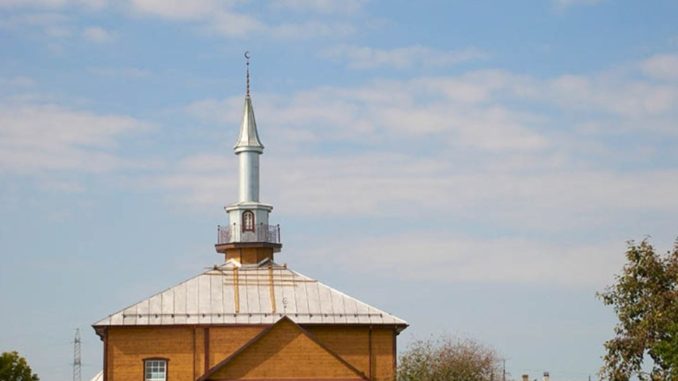
The Ivye Mosque was built in 1884 with the permission of the Taurida Muftiate of the Russian Empire. It is a rectangular building with a pentagonal mihrab extension covered by a hipped roof. An octagonal minaret stands in the center of the mihrab. It is surrounded by a balcony and topped with a tall spire. The mosque’s interior is divided into men’s and women’s halves with separate entrances.
“In addition to prayers,the mosque regularly hosts Islamic studies classes for both adults and children,” said I. Shabanovich. ”Attendancevaries, but interest in the faith remains, albeit in different forms.”

Community life
Over six centuries of proximity to the inhabitants of the Blue-Eyed, the Tatar culture has become closely intertwined with the local one.
”We don’thavethe flashy costumes orunusualdishesthat usually surprise guests.Belarusian and Soviet songsare playedat Tatar weddings, and the national cuisine is largely similar to that of Belarus, ” the interviewee explains. ”However, the most important thing we’ve managed to preserveis our attitude toward religion.Thanks to the mosque’s continued operation ,the most important religious rites—funerals, family rites,holidays —continue to exist, and on Fridays, collective prayers are held there.”

Friday is a sacred time for Muslims. It is on this day of the week that the congregational prayer, Jumu’ah prayer, is performed.
”The obligatory portion lasts about 15 minutes, but with additional prayers, the service can last at leastanhour, ” explained I. Shabanovich.“During this time, people tend to leave their work and join the community.”

Beauty in simplicity
Discussing the attitude towards religious doctrine, I. Shabanovich noted:
”Religionis not a hobby orentertainment, but awayoflife. Any religionteaches morality,respect forelders, and kindness to neighbors.”
Moreover,in Islam, a neighborisnot only the one who livesbehindthe fence, butfortyhouses away in all directions.
The Ivye Mosque is frequently visited by tourists and official delegations from various countries. The chairman of the local Muslim community particularly remembers the visit of representatives of the Saudi Arabian government.

”Their mosques areallmarble, gold, and opulent, whileoursiswooden, old, andmodest.This is precisely whatstruckthe guests. It’s not for nothing that they say: beauty lies in simplicity. It’s not for nothing that our mosque is called the Belarusian Mecca.”
Prepared by MilanaZagorskaya
Photo by the author
Originally published at MinskNews.by
Good looking building. But strange that Saudi Arabia did not help them with funding.